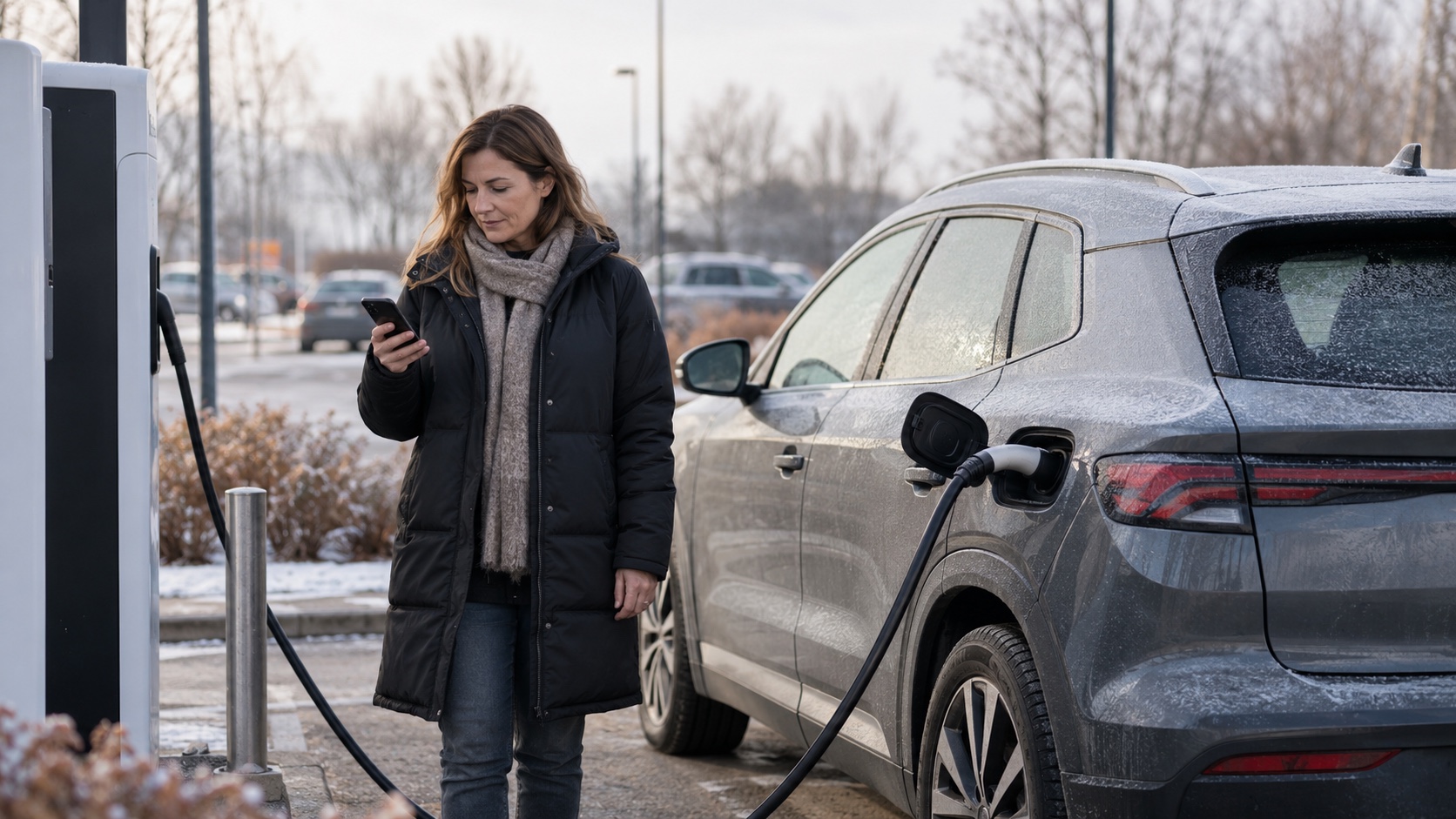
AI-generated editorial illustration of a driver at a winter charging stop; the unbranded vehicle and station are conceptual, not a model-specific demonstration.
A winter range plan is more useful than a single percentage estimate. Start with the vehicle, route and charging conditions you will actually face.
The first cold road trip can make an electric vehicle's familiar range estimate feel less predictable. Cabin heat, battery temperature and road conditions can change the journey. For drivers planning Thanksgiving visits or later winter travel, the useful response is a route and charging plan that allows for those conditions.
There is no single cold-weather range penalty that describes every EV, temperature and trip. A number from a different vehicle or a different test may be informative without predicting what your own car will do on a particular morning.
Prepare while the car is plugged in
The U.S. Department of Energy's winter EV guide recommends preconditioning while connected to a charger and, where possible, using covered parking. Warming the vehicle before departure can draw on external power rather than relying entirely on energy stored for the drive.
Read the instructions for your model. Cabin preheating and battery preparation for rapid charging may be separate features with different triggers. Setting a destination in built-in navigation may behave differently from simply entering an address in a phone app. Confirm the procedure rather than assuming every EV manages temperature in the same way.
Use the manufacturer's charging recommendations, including any guidance for your battery type. A generic winter checklist should not replace the owner's manual or turn a particular charging target into a rule for every vehicle.
Build in a charging alternative
Before a longer drive, identify the planned stop and a realistic alternative. Check connector compatibility, access hours, recent availability information and any account or payment setup required. Confirm whether an adapter is supported by both the vehicle and the charging network; physical fit alone does not establish compatibility.
Leave enough flexibility to change the plan if a charger is unavailable or the vehicle uses more energy than expected. Reassess along the route using the car's current estimate and the next available stops. A theoretical arrival with almost no remaining charge leaves little room for a diversion.
Charging time should be treated as a planning range rather than a guarantee. Battery condition, temperature, state of charge and the station can all affect the session. Check the vehicle's instructions for preparing the battery before a fast-charge stop, and avoid assuming that the largest number on a charger will be the power the car receives.
Winter preparation extends beyond the battery
The National Highway Traffic Safety Administration's winter driving guidance notes the effect of cold on EV and hybrid range and emphasizes basic vehicle preparation. Tire pressure should be checked against the vehicle manufacturer's specification. Cold weather is a reason to check it, not to substitute a pressure found on an unrelated car or the tire's maximum sidewall marking.
Inspect tires, lights, wipers and the supplies needed for the conditions. Carry suitable warm clothing and emergency items, and account for road closures or deteriorating weather. An EV's range display cannot answer whether a road is safe to travel.
For a first winter journey, allow more flexibility than you would on a well-understood summer route. Note how your particular vehicle behaves and use that experience to refine the next trip. Preparation is most useful when it reduces the number of decisions that have to be made with a cold battery, a low charge and few alternatives.
Find more practical vehicle coverage in Taken Social's Cars section.
Reporting and source information checked November 1, 2026.