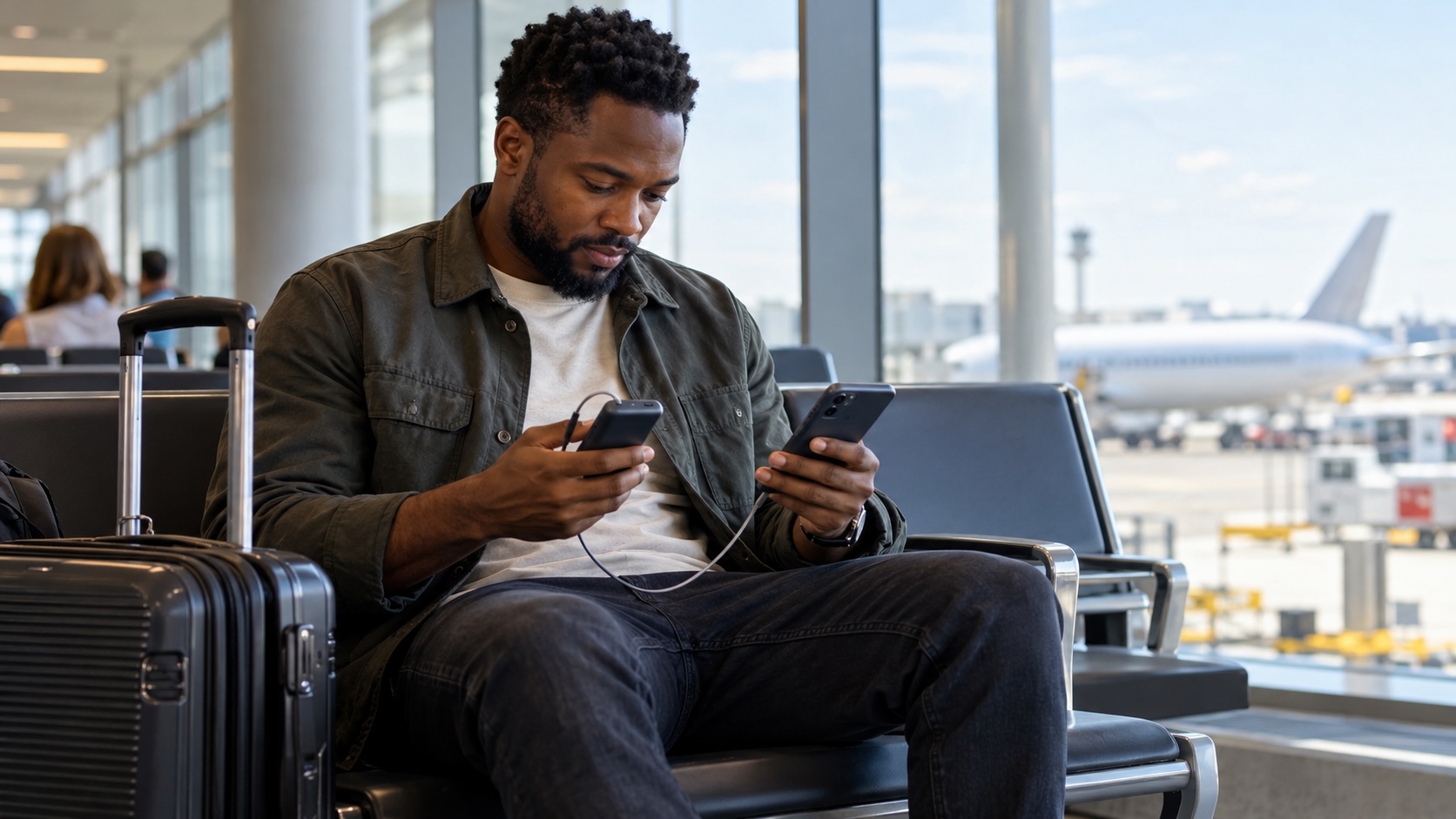
AI-generated editorial illustration of a traveler checking an unbranded power bank; no particular product has been tested or endorsed.
Charging speed, stored energy and permission to fly are different questions. Read all three before buying a portable charger for holiday travel.
A power bank can have a large capacity number on its box and still be a poor match for a laptop, a heavy addition to a day bag or the wrong choice for a flight. The label needs to answer several questions that shoppers often compress into one: how much energy it stores, how quickly it can deliver that energy and where it can be carried.
This research-based guide explains the comparison using current standards and travel guidance. It does not claim hands-on testing, measured capacity or a best-performing product.
Separate watts from watt-hours
Watts describe power output. Watt-hours describe stored energy. Milliamp-hours express charge capacity at a stated voltage, so the mAh figure alone is not a complete basis for comparing batteries with different voltage assumptions. The FAA gives the conversion as volts multiplied by amp-hours; 1,000 mAh equals 1 Ah.
Check the manufacturer's Wh marking rather than inventing a voltage for an airline calculation. For charging performance, read the supported output of the individual port and how it changes when multiple devices are connected. A combined maximum is not necessarily the power available from one port.
The USB Implementers Forum's Power Delivery overview describes a standard capable of delivering up to 240W. That is a capability of the specification, not a promise that every USB-C power bank, cable or device supports it. Match the bank's published charging modes to the device and use a suitably rated cable.
Check the airline, not just the airport rule
The FAA's current lithium-battery guidance, updated August 11, 2026, requires power banks to travel in carry-on baggage. If that bag is gate-checked, remove the power bank and keep it in the cabin. Protect it from damage and short circuits.
The FAA lists a usual 100Wh limit for lithium-ion batteries and an airline-approval provision for certain larger spares. It also warns that airlines can impose stricter power-bank limits. Do not assume that an approval provision or a general battery quantity allowance establishes what your carrier permits for portable chargers.
Southwest's current policy, for example, limits each customer to one power bank of no more than 100Wh, effective April 20, 2026. It also specifies storage and onboard-use conditions. Those are Southwest's requirements, not a universal rule for all airlines. Check every operating carrier on the itinerary before travel.
Inspect the product you actually own
Before packing an existing charger or buying a discounted one, look up the exact model and relevant identifiers in the CPSC recall database and on the manufacturer's site. A brand name alone is not enough to identify an affected product. Follow the specific recall instructions if yours is included.
The FAA's battery-in-baggage summary says damaged, defective or recalled batteries should not be carried aboard. A swollen or damaged pack is not something to test on the way to the airport. Seek the manufacturer's disposal guidance rather than putting a suspect lithium battery in ordinary household trash.
Choose around the trip you are taking: the devices, charging modes, weight, clearly marked energy rating and carrier restrictions. The largest number on the box matters less than whether the whole setup works for that use. Find more buying guides in Taken Social's Products & Reviews section.
Reporting and source information checked November 1, 2026.