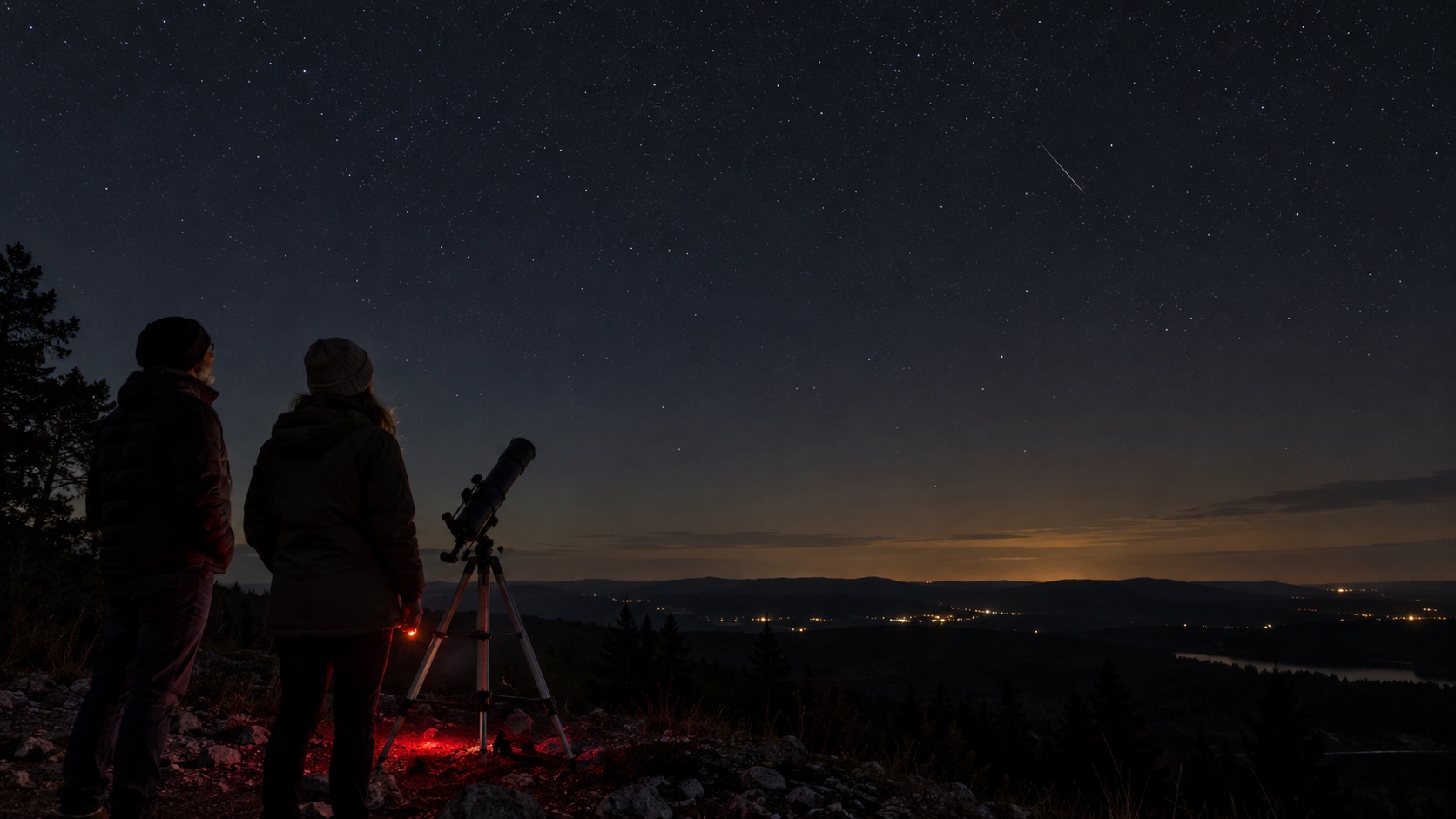
AI-generated editorial illustration of a stargazing outing; the sky is conceptual and is not an astronomical chart or a record of the 2026 Leonids.
The month offers several reasons to step outside after dark. A good location and the right expectations matter more than an expensive telescope.
A meteor shower is an invitation to wait. Unlike a bright planet, it does not stay in one place while someone adjusts a telescope. The most useful equipment for November's Leonids may be a warm coat, a comfortable chair and enough time to let the sky reveal itself.
NASA's 2026 skywatching calendar highlights the Leonids in mid-November and a supermoon on November 24. These are observing opportunities, not guarantees about the weather or the number of meteors any one person will see.
Put the Leonid observing window in local time
The Royal Observatory Greenwich's November guide points to the early morning of November 18 for the Leonid peak. For U.S. readers, that means checking an observing guide for their location and time zone when planning the night of November 17–18. Peak predictions are global; an individual observer still needs darkness and a view of the sky.
The Planetary Society's monthly guide describes the Leonids as a modest shower associated with debris from comet 55P/Tempel-Tuttle. Its typical dark-site rate of roughly 10–15 meteors an hour is an idealized expectation, not an appointment for a shooting star every few minutes in a bright suburb.
That distinction can save an evening from disappointment. Allow time rather than setting a five-minute challenge. Pick a broad, unobstructed view and resist the urge to stare at a phone after every quiet interval. Meteor watching is better suited to the unaided eye than to the narrow view through a telescope.
Make the outing workable before making it ambitious
Choose somewhere you are permitted to be after dark. Check access hours, weather and the condition of the ground in daylight if the location is unfamiliar. An accessible nearby site that you can use comfortably is often a better plan than a remote destination with uncertain access.
Bring layers, a seat and a way to keep your hands warm. Arrange a meeting point if a group will arrive separately. A dim red light can help with finding equipment without repeatedly flooding the area with white light; keep any light directed away from other observers.
Start with a short trial session earlier in the month. It gives you a chance to discover whether a streetlight, building or tree blocks the view you expected. That practical reconnaissance is more useful than buying equipment before knowing the site.
The November 24 Moon offers a different experience
NASA also flags November 24's full moon as a supermoon. The term describes a full moon occurring relatively close to Earth in its orbit. It does not mean an enormous disk will dominate the landscape as some composite images suggest.
For a casual outing, check the local moonrise time and choose a safe view toward the horizon. The Moon is a forgiving starting point for someone new to skywatching; a meteor shower asks for patience, while the Moon offers a subject you can return to throughout an evening.
Keep the two plans separate. A bright Moon and a dark-sky meteor watch reward different conditions. November has room for both, provided the calendar serves as a starting point rather than a promise of a particular view. Explore more ideas in Taken Social's Lifestyle section.
Reporting and source information checked November 1, 2026.