Most U.S. clocks moved back one hour on November 1. A live official clock is the best reference when two devices disagree.
For the current time in the United States, start with time.gov, the official time service linked by the National Institute of Standards and Technology. Select the relevant zone and allow the live clock to synchronize. A time printed inside an article—or visible in a photograph—cannot remain the current time as the minutes pass.
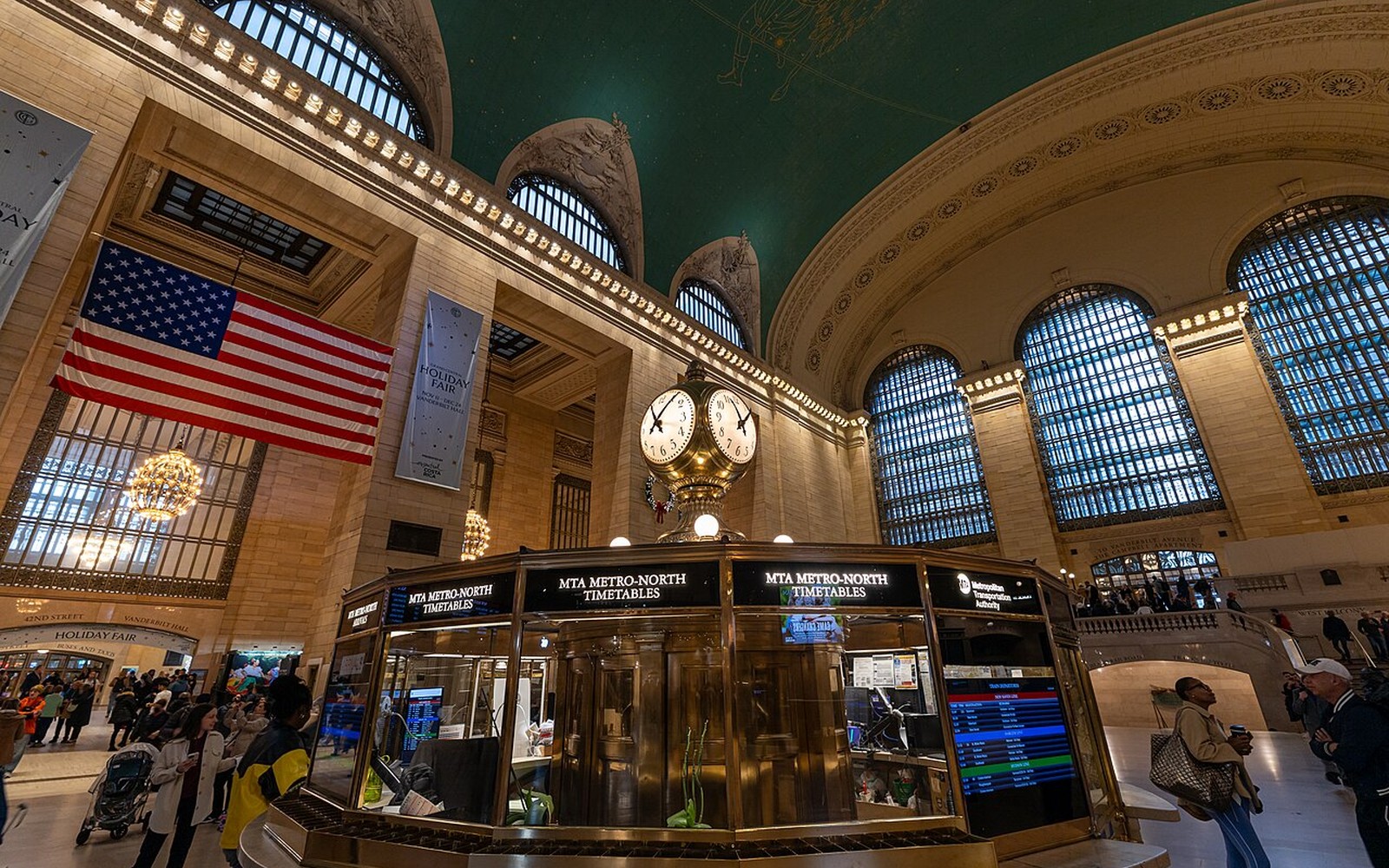
File photo: The information-booth clock in Grand Central Terminal, New York, on November 21, 2024. The photographed clock does not show the current time. Photo: Superbass. Source photograph · CC BY-SA 4.0.
The question is especially common today because daylight saving time ended in most of the country on Sunday, November 1, 2026. Some devices adjusted automatically; others still need attention.
Did the clocks move back today?
Yes, in places observing the U.S. daylight-saving schedule. NIST's 2026 rules set the change at 2 a.m. local time on November 1, when the clock returned to 1 a.m. That hour occurred twice as standard time resumed.
Hawaii and most of Arizona do not observe daylight saving time. NIST identifies the Navajo Indian Reservation as an Arizona exception that does observe it. The U.S. territories listed by NIST also have their own treatment, so a blanket instruction to change every American clock would be wrong.
The practical starting point is location. Establish which time zone and daylight-saving rules apply before manually moving a clock that may already be correct.
Which U.S. time zone should I check?
The official time page displays the standard-time offsets for the four main contiguous-U.S. zones:
- Eastern Standard Time: UTC−5.
- Central Standard Time: UTC−6.
- Mountain Standard Time: UTC−7.
- Pacific Standard Time: UTC−8.
For a simple standard-time example, noon in New York corresponds to 11 a.m. in Chicago, 10 a.m. in Denver and 9 a.m. in Los Angeles. These are example conversions, not a claim that it is currently noon anywhere.
Time.gov also displays Alaska, Hawaii and other non-contiguous U.S. and territorial zones. Use the appropriate entry rather than forcing a location into one of the four familiar mainland labels.
What if my phone and another clock disagree?
Compare each with the official service for the same zone. Then check the device's automatic-time and time-zone settings. NIST explains that local-zone and daylight-saving corrections depend on the operating system, making current software and the correct location settings important.
For an appointment, flight or game, confirm the date and named time zone in the organizer's own listing. A correct clock cannot repair a calendar invitation entered for the wrong city. When coordinating across regions, include both the date and zone instead of sending a bare hour.
The quickest answer is a live official clock, followed by the right local setting. For a broader explanation of today's transition, see Taken Social's November clock-change report.